
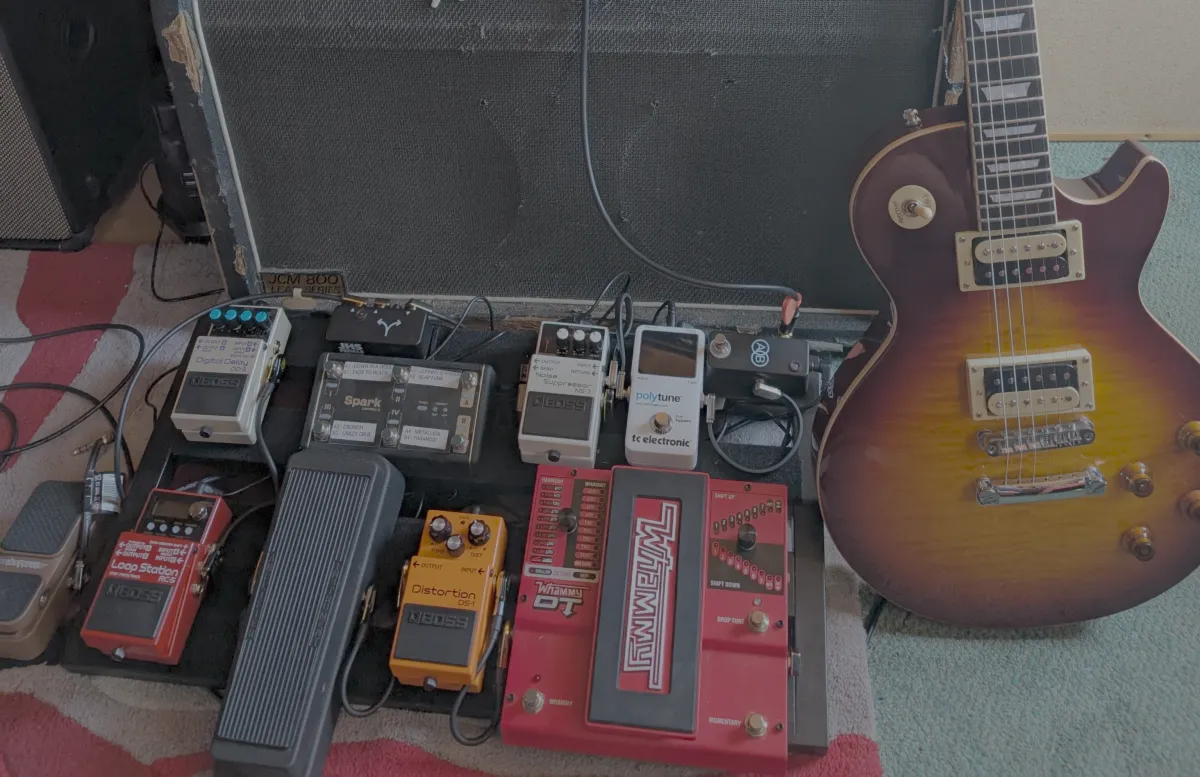
Mia's main rig is a Quad Cortex and a small pedalboard.
That's it — not a stadium setup, not a museum of vintage gear, not a truck full of cabinets. The Quad Cortex handles the amp palette: Fender clean, Vox chime, Marshall crunch, the Mesa rectifier sound, the Soldano lead tone, whatever else the song asks for. The pedalboard handles the things the digital chain still doesn't quite get right — a Digitech Drop and a Whammy for the pitch work, an actual Cry Baby because no model has ever felt right under the foot, and a Klon and a Dumble for the gain stages where the original article matters. For acoustic, a custom piezo preamp that doubles as a clean boost for the Strat. We may digitise that pedal row eventually. For now they sit outside the box, and the box is better for it.
That hybrid setup — digital for the amps, real pedals for the bits that still want to be real, plus a wireless and a couple of cables — is what makes shows like Baroque to Rock and The Electric Age possible without a truck full of vintage amps behind you. 40 years of guitar history, played accurately, by one player, staying true to the original songs. Fifteen years ago this rig wasn't possible at this price point. Forty years ago it wasn't possible at any price point.
That shift is the thing this post is about. So it's worth being honest about how we got here.
The Old Regime
In the analog era, tone cost money. Not a bit of money — proper money. If you wanted a Marshall stack sound you bought a Marshall stack. If you also wanted a Fender Twin's clean shimmer and a Mesa's gain, you bought all three, and you paid someone to switch between them while you played. The rigs you saw on stadium tours weren't aspirational, they were architectural.
Working musicians didn't have that. Working musicians had one amp, a couple of pedals if they were lucky, and a volume knob.
The Evolution
The Analog Era (1950s–1980s)
One amp. Maybe a fuzz, maybe a wah. Whatever else you needed, you got with your fingers and the volume knob on your guitar.
It wasn't a creative choice, it was a budget. The tone you could chase was capped by what you could carry up the stairs of whatever venue you were playing and what you could afford on whatever you got paid for the gig. Innovation moved at the speed of whichever amp tech happened to live in your town.
The Rack + MIDI Period (1980s–1990s)
Then came the racks. 19-inch flight cases, MIDI switchers, preamps stacked four high. You could recall a clean tone on one footswitch and a saturated lead on the next, and the audience couldn't see the cabling because it was all hidden up the back of the stage.
The price was the catch. The rigs on those stadium tours cost more than most musicians earned in a decade. The gap between what you heard on the record and what you could produce yourself got wider, not narrower. The professionals pulled ahead, and everyone else stayed standing in front of one amp.
Early Modelling Phase (2000s–2010s)
The Line 6 POD turned up and split the room.
On one side, bedroom players who finally had something that didn't wake the neighbours and gave them more than one sound. On the other side, every guitar magazine letters page calling it sterile, fake, plastic. They weren't completely wrong — the early units did sound a bit like a guitar amp on a phone call. Close-ish, but not there. The promise was real and the execution wasn't quite, and the purists were entitled to their scepticism.
The main thing they got wrong was about the speed of progress. The technology was bound to improve; the only uncertainty was how quickly.
The Neural Era (2020s–Present)
It got a lot better.
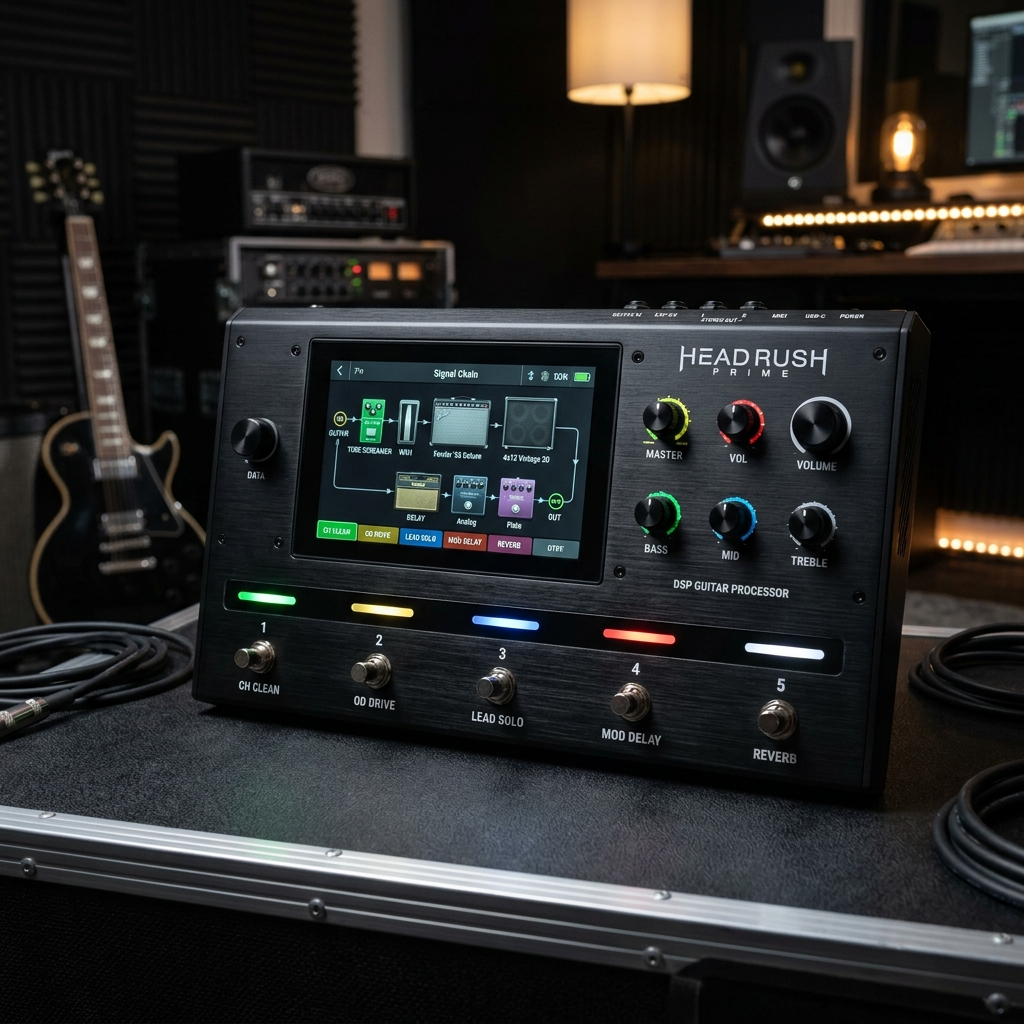
Modern units — Quad Cortex, Headrush Prime, Fractal's FM9 — don't model amps any more. They capture them. You point the unit at the actual amp in the actual room, it learns the amp, and what you get back is, for practical purposes, the amp. A/B blind tests against mic'd cabs aren't reliably winnable by professional engineers, never mind audiences.
The debate has settled. Digital technology surpassed analog not by replacing it, but by capturing it faithfully and making those sounds portable. The argument is over. Digital didn't beat analog by replacing it. Digital won by capturing it perfectly and then making the capture portable.
For Mia, that's not a theoretical observation. It's the reason the Radio in Chains set works — Layne Staley's guitar tones on "Man in the Box" and Jonny Greenwood's on "Paranoid Android" are not sounds you get from the same amp. In 1995 you'd have needed a different rig for each band. In 2026 it's a different preset on the same box, switched with a footswitch, with no gap and no drop.
The Whole Rig
There's a thing that happens at every soundcheck now that wouldn't have happened twenty years ago. The engineer asks what's in the chain, Mia points at the Quad Cortex and the board in front of it, and that's the entire conversation. No mic placement debate, no checking which speaker is wired up, no worry about whether a 50-year-old vintage amp is going to behave on a damp Tuesday in Belfast.
The amp side of the rig — every preamp, every cabinet IR, every effect block around them — lives as encrypted preset files on the Quad Cortex. Backed up, swappable, immune to airline baggage handlers, immune to the venue's mains hum, immune to the amp tech being on holiday. If the unit got stolen tomorrow we'd buy another one, load the presets off the backup, and lose nothing.
The pedalboard is the visible half. None of it is irreplaceable — a Klon for a Klon, a Cry Baby for a Cry Baby. None of it is fragile. None of it sits in a flight case behind a crew of techs. The whole rig — QC and pedalboard together — fits on a fold-out table.
That's the part that's quietly revolutionary. It's not that the tone is better — although it is. It's that the tone is protected. A 16-year-old guitarist's signature sound now travels in a single case of gear, not in a transit van.
What This Actually Means
Geography used to set the ceiling. If you grew up somewhere with a good music shop and a good amp tech and a parent who could afford to keep buying you gear, you had a different palette than someone growing up somewhere that didn't have any of those.
That ceiling has come down. A teenager in Portaferry with a modeller and a laptop has access to the same tones as a teenager in Los Angeles, and both of them have access to tones that an actual stadium act in 1985 couldn't have got even with a crew of technicians. The technical floor is now high enough that what separates one player from another isn't gear, it's the hours.
The Trinity Grade 8 doesn't get easier because the rig got better. The hours behind it are the same as they were in 1985. But the tone you put on top of those hours — that's no longer something you have to inherit or be born near. That's the bit that changed.
This is what we mean by the democratisation of tone. The technology didn't replace musicianship. It removed an obstacle that was sitting on top of it.
And for us, the obstacle being gone is what makes a project like The Electric Age work in the first place — 40 years of guitar history played accurately, in one set, by one player, without needing a museum's worth of vintage amplification behind her. The legends get honoured properly because the tools have finally caught up.
That's also, separately, why tribute bands matter — but that's a different post.