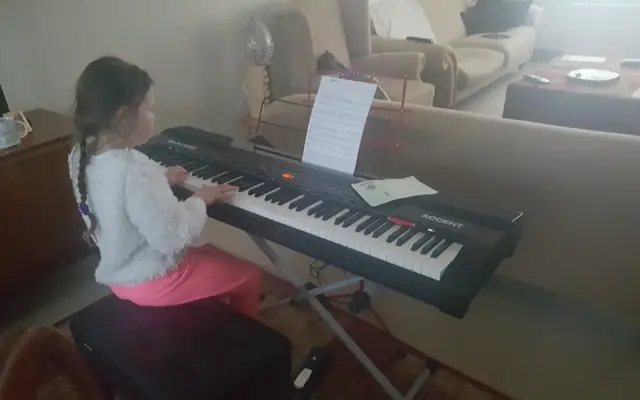
I've been playing piano since I was four. ABRSM put me through Grade 2 the summer I turned seven, and Grade 5 the summer I turned nine. Trinity took me through Grade 7 at fourteen. The certificates are framed in a row at home and they look the same as anyone else's certificates — the same copper-foil border, the same signature from someone I've never met.
But I picked up a guitar properly for the first time around fourteen. And I'd just sat my Grade 8 Distinction in Rock & Pop Guitar — Trinity, regulated as a Level 3 qualification by Ofqual, the same regulatory tier as an A-Level. Two years from zero to Grade 8. I picked up a Classical Guitar Merit somewhere in the middle, almost in passing, because the technique transferred. I didn't carry on with the classical syllabus. It wasn't where I wanted to live.
What I want to talk about isn't the certificates. It's the bit you don't see.
The Signal in the Soreness
Grade 8 came down to three pieces: Crazy Train, The Trooper, and Paranoid Android. They sat in my hands for months.
The Trooper is the one that keeps coming back to me. There's a section where Dave Murray's gallop meets Adrian Smith's harmony lines and you have to hold pressure on the fretboard for long stretches.
Most people hear the line from Bryan Adams' Summer of '69 — "played it till my fingers bled" — and think of a summer, a girl, a first guitar. Bryan wrapped it in so much warmth that the literal line disappears into the nostalgia.
But if you've ever actually done it — sat with a piece that's too hard for you and refused to put it down until it wasn't — you know he meant exactly what he said. It's not a metaphor. You bleed a bit. Or you don't, but your fingertips throb for a day.
The Maintenance of Mastery
Here's the thing nobody tells you when you start: callouses aren't a reward you earn once. They're maintenance.
Two weeks away from the guitar and mine soften. A week off and I can feel the strings biting again when I come back. The hours don't accumulate into some permanent badge. They accumulate into a state you have to keep renewing.
This is true for the piano too, but quieter. The piano doesn't bite back the same way. When you're learning it as a child, the discomfort is in your back, your wrists, the patience to sit still long enough to make a piece sound like the recording. The guitar is more honest. The guitar tells you, every single time, whether you've been doing the work.
I went from no guitar to Grade 8 in roughly two years. People sometimes ask me how. The answer they're looking for is something like natural talent or Trinity grades I'd already done or good teacher. All of those helped. But the real answer is that for those two years, my fingertips were always slightly sore, and that was the point. Build the resistance and calluses early, it will stay with you for life.
Comfort is the Enemy
That's why the Bryan Adams line hits differently now than when I first heard it. It's not a story about one summer. It's what staying in it looks like. Forever. You don't get to the other side of the pain and then float. You just get better at walking with it.
The classical training I did as a child was a different shape of the same thing. Grade 5 ABRSM piano at nine isn't a story about a gifted child; it's a story about a small child sitting on a piano stool for an hour every day after school for three years while her friends were outside, because every day there was a piece slightly harder than the one she could already play. The gift, if there was one, was being okay with the fact that the piece always wins for a while before you do.
The useful part, if you're starting out: the soreness is the signal.
Comfort is the enemy of progress. The pieces that leave your hand aching are the pieces doing the work. The callouses — when they come — are proof. Not that you've arrived, but just that you've been showing up.
That's all the certificates really say. Not good. Just: kept showing up.
— Mia
Miabella is a rock, grunge and metal act from Northern Ireland, fronted by guitarist and pianist Mia Nesbitt. The project is being built live-first: rooms, audiences, evidence, then recordings.