
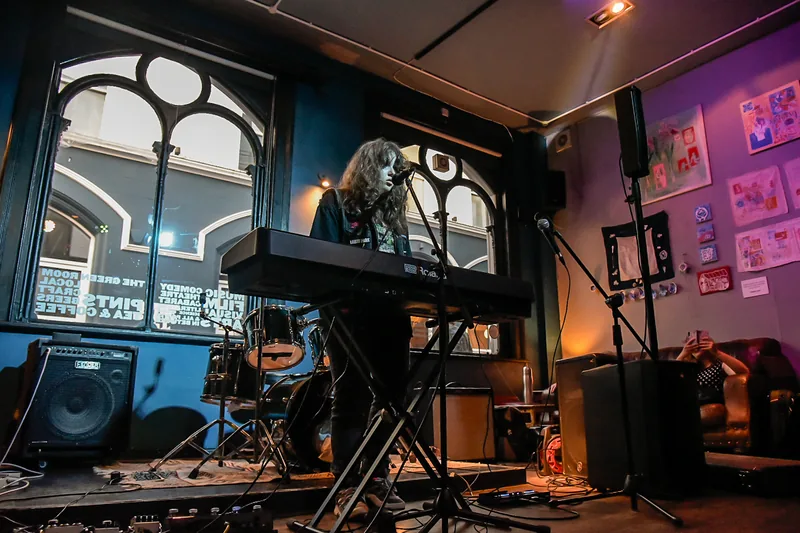
We get the same question from three different kinds of people.
The couple planning a wedding asks: can you do a full day? The corporate booker asks: can you do background and then a set? The person throwing a 50th asks: can you just come and play?
The answer to all three is yes. But the music doesn't work the same way in each one. Not the songs — the structure. The shape of the night. How you enter a room, what the room expects when you start, and how long it takes before the crowd is yours.
Nobody explains this. Most acts don't think about it. They show up, play the set, go home. The set is the set. That's why the same band can be brilliant at a wedding and wrong at a corporate dinner — not because they played badly, but because they played the wrong shape.
A wedding is a four-act structure
We've written about this before. A wedding is a long-form event — six to eight hours of music across four distinct phases, each with a different energy, a different volume, and a different job.
Act one: the ceremony. Classical piano. Debussy, Yiruma, Chopin. The room is small, the moment is formal, the music is there to hold the space without competing with it. This is the quietest and most controlled playing of the entire day. Every note is deliberate. You don't play loud. You play precise.
Act two: the drinks reception. Acoustic guitar and piano. The couple has just got married. Guests are mingling, hugging, finding their seats. The music needs personality without volume — something warm enough to fill a room but quiet enough that two people can talk across a table. Stripped-back arrangements. Recognisable songs played in a way that makes people lean in rather than step back.
Featured performance
Blackbird (The Beatles Cover)
Act three: dinner. Piano-led. Softer again. The room is eating. You're not the event — you're the atmosphere. The worst thing you can do during dinner is try to be noticed. The best thing you can do is make the room feel like it has a pulse without anyone being able to point at why.
Act four: the evening set. Electric. Full band. Stage presence. This is where the night turns. But it's earned — the room has been listening to you for five hours. They already trust the musicianship. They've heard Chopin at the ceremony and acoustic Alice in Chains during cocktails. By the time you hit the first riff of the evening set, you're not a function band warming up a cold room. You're the same artist they've been with all day, and the volume just arrived.
That arc — quiet to loud, formal to release, piano to electric — is what makes a wedding set fundamentally different from every other kind of event.
That arc is what makes a wedding set fundamentally different. You can't shortcut it. You can't play Act Four energy at Act One. The day earns its finish.
A corporate event is a two-act structure
Corporate is the format most bands get wrong. Because on paper it looks simpler: background music during dinner, then a live set. Two things. Easy.
It's not easy. It's harder than a wedding in one specific way: the transition.
At a wedding, you've had six hours to build trust. At a corporate event, you've had ninety minutes of background piano while people ate salmon and talked about Q3 targets. They weren't listening to you. They were listening to each other. The piano was furniture — good furniture, but furniture.
Then the tables get cleared. Someone taps a glass. And now you're supposed to get a room full of people who've been in work mode all day to stand up, walk to a dancefloor, and care about live music.
The first song of the live set at a corporate event is the most important song of the night. It can't be a slow build — the room doesn't have patience for a slow build because they haven't been on a journey with you. It needs to be immediate, recognisable, and high enough energy that the first three people who stand up don't feel exposed.
The background set matters too, but differently. At a corporate dinner, the background music isn't building toward anything. It's creating an atmosphere that says this is a proper event, not a conference with a buffet. Piano works. Acoustic guitar works. Anything with vocals during dinner doesn't work — vocals compete with conversation, and at a corporate event, the conversation is the point.
The set itself runs shorter and hotter. Sixty to ninety minutes. No valleys. A wedding set has peaks and valleys because the crowd is committed — they're staying until midnight regardless. A corporate crowd will leave when they're done. You don't get two hours to build an arc. You get four songs to prove you're worth standing up for, and then you hold them.
A private party starts at the top
This is the format that's actually the most fun to play and the hardest to get right in a different way.
A 50th birthday. An anniversary. A house party with a marquee. No ceremony. No dinner service. No corporate formality. The host has invited people they actually like, put a bar in the garden, and booked a band.
The room is already warm when you start. People are already drinking. They already want music. There's no building to earn — the party started before you plugged in.
So you open with the big hitters. Not a soundcheck song, not a gentle opener, not a slow burner that builds over three minutes. First song, first riff, full energy. The reason: the crowd has no patience for you to find your feet because they've already found theirs. If the first song doesn't match the energy of the room, you're behind the room — and catching up at a private party is harder than it sounds, because there's nothing structural (dinner service, speeches, a first dance) to reset the room's attention.
The set is also the most flexible format. No timeline from a wedding planner. No corporate schedule. If a song lands and the room wants more of that, you lean into it. If the crowd is older, you shift the setlist in real time. If someone's dad is air-guitaring to Black Sabbath, you play more Black Sabbath. The skill isn't in the planning — it's in the reading.
Why this matters when you're booking
The point isn't that one format is better than another. It's that the same band playing the same songs will sound completely different depending on the shape of the night. And if the band doesn't understand that shape, the music won't land — not because of talent, but because of timing.
When we get an enquiry for a corporate event in Belfast, we don't send the same proposal we'd send for a wedding. The repertoire overlaps — Miabella plays the same songs — but the running order, the pacing, the transition strategy, and the opening song are all different. Because a room full of wedding guests who've heard you play Chopin at three o'clock is a fundamentally different room from a corporate crowd who first heard you at seven.
A wedding is a narrative. A corporate event is a pivot. A private party is an ambush.
Same band. Same musicianship. Different architecture.
The practical version
If you're trying to decide what kind of event music you need:
- Weddings — you want a full-day structure. Ceremony through to evening. The act should be able to cover classical, acoustic, and electric, and the day should feel like one coherent experience. See the weddings page.
- Corporate events — you want someone who understands the transition from background to live, and who won't open with a ballad when the room needs energy. See the private events page.
- Private parties — you want flexibility and energy from note one. No dead air, no warm-up, no waiting for the room to come to you. You go to the room.
If you're not sure which format fits your event, that's a fine reason to get in touch. We'll tell you what shape makes sense and what doesn't, before anything gets booked.
Ready to book?
Same Band, Your Night
Tell us about your event — what kind of atmosphere you're building and what you need the music to do. We'll build the shape from there.
Get in touch#CorporateEvents #PrivateParties #WeddingBand #Belfast #NorthernIreland #LiveMusic #EventStrategy #RockBand #MusicArchitecture