
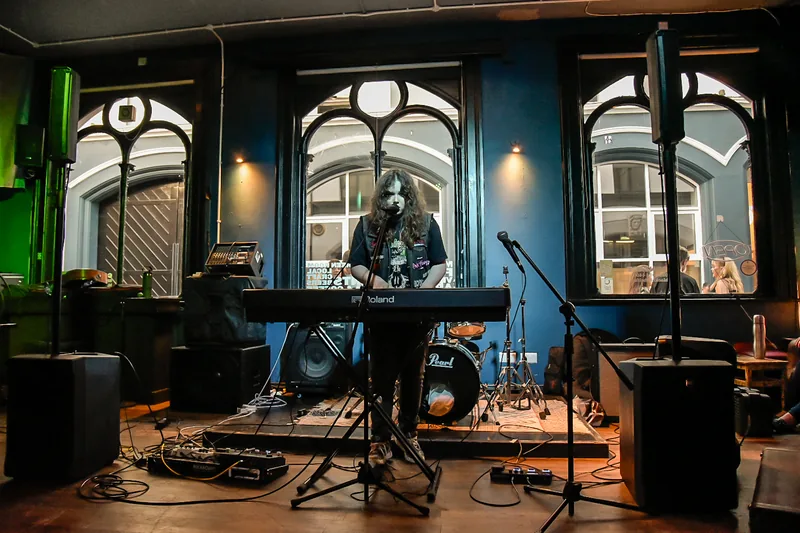
I'm Jody. I manage the band you've just landed on — and since the frontwoman is my sixteen-year-old daughter, the rest of them call me the dadager. A big part of the job is answering the question every couple eventually puts to me: live band, or DJ?
So here's the manager of a wedding band telling you, in writing, when to book a DJ instead. It's the honest version of this question, and it's the one nobody trying to sell you either thing wants to put on a page.
Type live band or DJ? into Google and the results line the two up like a spreadsheet — cost, space, song variety, guest interaction — and declare a winner. I want to do something more useful, because after a few years of booking Mia into both gigs and weddings, I've watched that spreadsheet send lovely couples to the wrong answer for entirely sensible reasons.
It's not band vs DJ. It's playlist vs event.
The real fork in the road isn't live versus recorded. It's whether you want the night to feel like a playlist someone is managing, or like an event that actually happened in that room, on that date, and nowhere else.
That reframe matters because a good DJ and a safe function band are far closer cousins than either would like you to think. Both can run a tidy, low-risk evening of recognisable hits that keeps the floor moving and offends nobody. If that's the night you want — and for a lot of couples it genuinely is — then the choice is mostly about budget and logistics, and we'll help you make it.
A good DJ and a safe function band are far closer cousins than either would like you to think. The real choice is playlist or event.
When a DJ is the right call (and we'll tell you so)
This is the part most band websites skip. A DJ is the smarter booking when:
Budget is the deciding factor. A DJ is the best value-per-hour in the room. Nothing a live band does changes that arithmetic, and pretending otherwise would be insulting.
You want maximum variety and the deep late-night catalogue. Garage into 90s R&B into a novelty singalong into the song from that advert — a DJ can pivot anywhere in seconds. No live band carries a thousand tracks.
The room is tight or the venue is hard-limited. If there's barely space for a cake table, or the venue clamps volume hard (more on that below), a DJ sidesteps the problem a band would spend the night fighting.
You want the music in the background. If your picture of the evening is atmosphere while people chat and graze, not everyone turned toward a stage — a DJ delivers that cleanly, and a band is the wrong tool.
If two or more of those are true for you, book a good DJ, enjoy your night, and skip the rest of this article with our blessing.
When you actually want a live band
A live band is the right call when you want a centrepiece — a stretch of the night that people stop and watch, that has a build and a peak, that they're still describing on the drive home. Recorded music, however well chosen, doesn't make a room hold its breath. Live music can.
We'll be straight about the trade: a band costs more, needs more space, and can't follow a request into a genre it doesn't play. You're buying impact and a sense of occasion, not infinite variety. If the occasion is the point, that's a good trade. If it isn't, see the section above.
The option nobody compares: not all live bands are the same
Here's the thing the comparison pages get wrong. They treat "live band" as one item. It isn't. There's the standard function band — two hundred songs on a list, a promo video of Uptown Funk, a price for four hours — and there's an act with its own identity, which is a different proposition entirely.
We don't learn your playlist the week before. We don't carry a 200-song catalogue. We have shows — a classical and acoustic set built on real musicianship, and a full electric set that moves through four decades of rock — and we shape a wedding day around them: piano for the ceremony, acoustic over the drinks reception, then the full band when the room is fed, settled, and ready for something to happen. That's not a function band with the edges sanded off. It's the opposite approach.
How a band built for headline rock shows ended up playing weddings at all is a story in its own right — I wrote it down in Why We Started Playing Weddings. The short version: someone who'd been at one of our gigs didn't want a wedding band. They wanted what we did on the Saturday night, at their wedding. That's a different request — and it's the one this whole chapter is really about.
Which is why, oddly, a safe function band and a DJ have more in common with each other than either has with us. Both are built to be unremarkable on purpose. We're built to be the part of the night people remember. Neither is wrong — but they're different products, and lumping them together as "a band" is how couples end up disappointed by a decision they thought they'd made.
What it costs in Northern Ireland — and what you're paying for
Most pages give you a vague range and move on. Here are real numbers. Treat the band and DJ figures as the going rate across NI, and the Miabella lines as our own pricing, so you can see exactly where an identity act sits.
Wedding DJ (NI): roughly £350–£1,400, averaging around £552. Best value-per-hour you'll find, and for a lot of evenings that's exactly right.
Full 4–5 piece wedding band (NI): typically £2,000–£3,000. This is the going rate for a proper live evening set with a full line-up — ours included.
Miabella — ceremony music: £250–£400. Live classical piano for the ceremony and arrival.
Miabella — cocktail / drinks-reception hour: £250–£400. Acoustic guitar and piano while the room is socialising.
Miabella — ceremony + cocktail bundle: £500–£800. The two daytime slots together, before any evening set.
Miabella — full electric evening set: sits within the 4–5 piece band range above. Add it to the daytime slots and you have one act covering the whole day.
The reason a band costs several times what a DJ does isn't the hours. It's that you're paying for a curated, paced, rehearsed performance built around your day — not a catalogue on tap. If what you value is the catalogue, the DJ wins on every line of that table. If what you value is the night having a shape and a peak, the band is the only thing that buys it. Decide which you're actually paying for before you compare prices, or you'll compare the wrong things.
The thing that quietly decides it: venues and sound limiters
The factor that settles more of these decisions than cost — and that almost no comparison page mentions — is the venue itself, and specifically the sound limiter.
Plenty of Northern Irish wedding venues, especially hotels and converted spaces near neighbours, run a noise limiter: a device wired to the stage power that cuts the electricity the moment volume crosses a set decibel level. A DJ can usually duck under it. A live drummer cannot make a kit quieter by asking it nicely. In a hard-limited room — anything around the low 90s of decibels or below — a full electric band can be neutered to the point where you've paid for impact you're contractually forbidden from delivering. In that room, honestly, a DJ or a stripped-back acoustic set is the smarter call, and we'll say so before you book.
The venue type tells you a lot before you even ask. Hotels and function suites are the most likely to limit and to restrict setup times. Barns and marquees give you space and volume but throw up power and acoustics questions — a generator that can actually carry a band, somewhere dry to set up, a ceiling that isn't a tin drum. Stately homes and dry-hire spaces are often the most band-friendly but the most logistically involved. Before you commit to any entertainment, ask your venue one question in writing: is there a sound limiter, and what level is it set to? The answer reshapes everything that follows.
Where we're not the fit
Honesty cuts both ways. If what you want is a traditional ceilidh or a trad-led Irish night, that's a specific and brilliant kind of band — and it isn't us. If you want pure, unobtrusive background music for the whole evening and nothing that asks for attention, that's a DJ or a quiet duo, not a full electric act. Naming who we're wrong for is the only way the "right for you" means anything.
"Best of both"? How a hybrid actually works
You'll see "band and DJ" sold as the best of both worlds, usually as a one-line afterthought. It can work, but only if someone has thought about the handover: who controls the room between live sets, whether the DJ and the band share a PA, who acts as MC, and how the transitions are paced so the energy doesn't fall off a cliff when the band steps down. Ask exactly how that coordination is handled before you assume it's seamless.
Our own answer to the same "we want variety and live energy" instinct is different: one act across the whole day, moving from classical piano through acoustic to a full electric set, so the variety comes from range rather than from bolting two suppliers together. Same problem, different solution — worth weighing both.
How to vet whoever you book (and the question nobody asks)
Whether you land on a DJ, a function band, or us, the same checks separate a safe booking from a gamble:
See them live, not just on video. A promo edit proves they own a camera. A real room proves they can hold one. We believe that strongly enough to back it: we offer couples complimentary tickets to one of our public shows for up to ten of the bridal party — come judge the standard for yourself before you commit to anything.
Confirm the act you book is the act that turns up. Ask whether it's the same musicians, every time, or a rotating roster booked through an agency.
Insurance and safety. Public liability cover (PLI) and PAT-tested equipment are non-negotiable, and most venues will ask for both anyway.
A written contract. Set times, arrival, the deposit and balance schedule, and — get this in writing — a clause covering what happens if the venue's sound limiter throttles the performance.
The question almost nobody asks: what's the backup? If a key performer is ill or a piece of gear fails on the day, what actually happens? Not one of the pages comparing bands and DJs answers this, and it's the one that protects your night.
So — which is right for your night?
Book a DJ if budget leads, you want the deep catalogue and late-night variety, the room is tight or hard-limited, or you want the music in the background. Book a function band if you want live energy but inside familiar, low-risk territory. And book an act with its own identity — like us — if you want the evening to have a shape, a peak, and a sound that's specifically yours rather than the default.
There's no universally correct answer. There's only the one that's right for the night you're actually picturing. If the night you're picturing sounds like a gig — elegant where it should be, then properly alive when it counts — that's the one we build.
If That's Your Night
Check Your Date
Tell us your venue and the atmosphere you're after, and we'll tell you honestly whether we're the right fit — sound limiter and all. You can come see us at a public show first.
Check Your Date#WeddingBand #WeddingDJ #Belfast #NorthernIreland #LiveBandVsDJ #WeddingEntertainment #AlternativeWedding #RockWedding #LiveMusic #WeddingPlanning